Ask a contractor how their business is doing and you'll usually hear a revenue number. We moved up on the ENR list. We're doing $80 million now, up from $60 million. It sounds like progress. But revenue tells you almost nothing about whether a business is actually healthy, and the industry's obsession with it might be one of the quietest reasons construction stays stuck.
Everyone's looking at the wrong number
Lists like the ENR 400 for general contractors and the ENR 600 for subs rank companies by revenue. So success gets framed as climbing a rank. It's an easy shorthand. Even people who know better catch themselves sizing up another company by asking how much revenue runs through it, as if that's the same thing as how good the business is.
It isn't. You can push enormous volume through a company and keep almost none of it. Revenue is how much money passes through your business. Margin, on the other hand, is how much stays. Those are very different things, and only one of them pays for anything that matters.
Revenue in construction comes bundled with risk
Here's what makes the revenue chase especially dangerous in this industry. Every dollar of construction revenue carries risk that a spreadsheet ranking never shows.
There's human risk. Night shifts, traffic near the crew, whether people got real sleep during the day before working. The kind of thing that keeps an owner up at night, because it should.
There's financial risk. You bid a two-year project by forecasting labor, equipment, subcontractor, and material costs, then you have to be right about all of them, not just today but across the entire life of the job. That's brutally hard to do, and getting it wrong doesn't just cost you the margin you planned, it can flip a job to a loss.
So chasing revenue at a thin margin means taking on maximum risk for minimal return. And the margins are thin. Industry data puts net profitability for companies in the $100 to $200 million range around 3%! Then factor in retainage of 5% to 10% and slow-paying receivables, and a huge number of contractors end up borrowing against a line of credit just to operate, paying interest that eats what little margin was there to begin with.
When you run the honest math, it gets uncomfortable. If you calculated the return on all the capital tied up in a low-margin construction business and compared it to a risk-free money market account paying a few percent, plenty of owners would be better off pulling their money out and doing nothing. Instead, a lot of them just buy more equipment, partly because Section 179 and bonus depreciation make another excavator feel like the smart tax move, without ever asking whether the business actually needed it.
The Hedgehog Concept
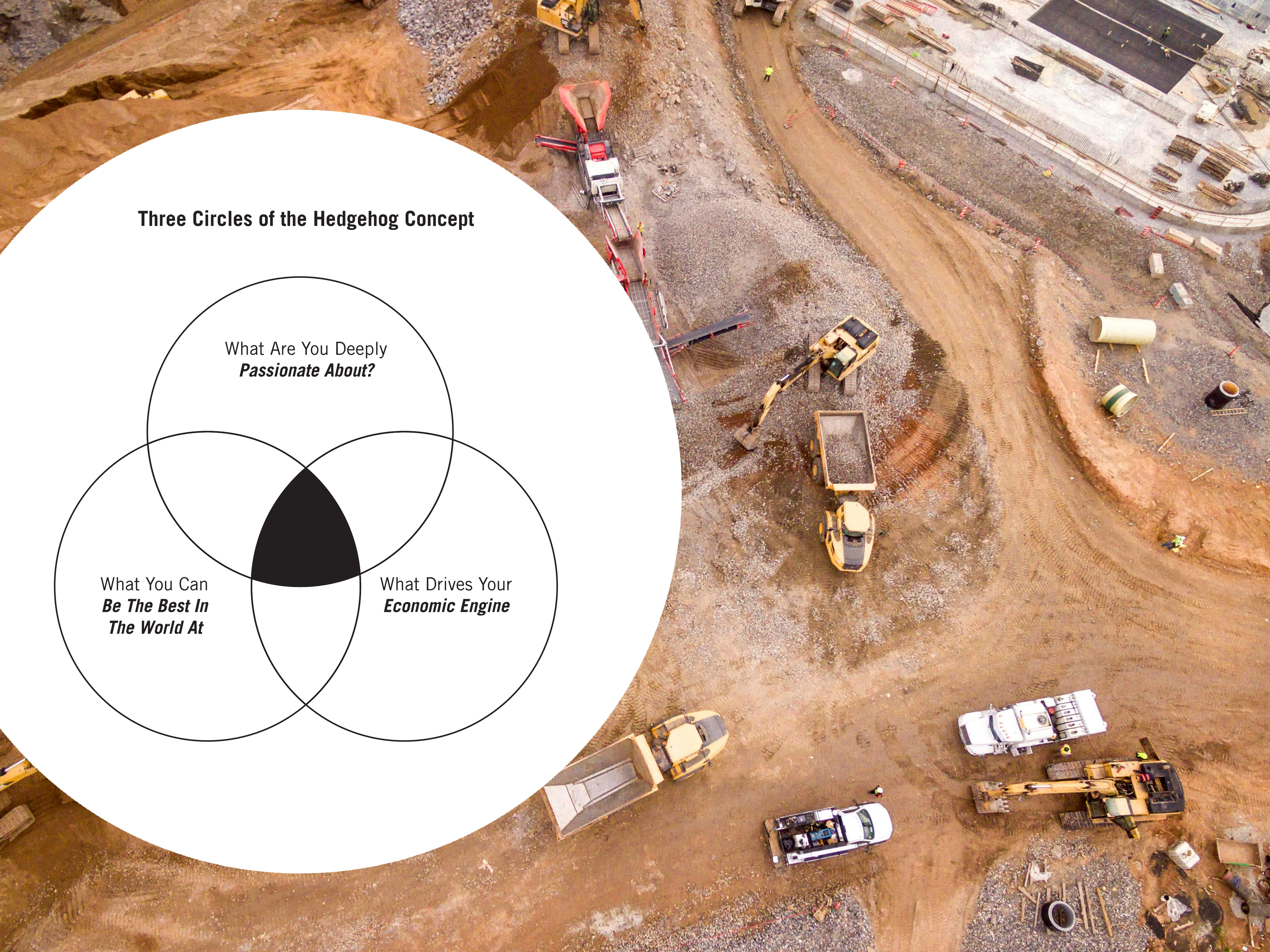
The way out isn't complicated, but it takes discipline. Jim Collins wrote about the Hedgehog Concept: the intersection of what you can be best in the world at, what drives your economic engine, and what you're deeply passionate about. It's easy to treat that as a poster on the wall. The better move is to treat it as a data exercise.
Mike Rawlings, the owner of Slate Rock Demolition, did exactly that. His team went back through their historical project data and sorted profitability three ways.
- By project size, they found something they didn't expect. They were making 20% to 40% margins on jobs under $100,000. Conventional wisdom says drop the small stuff and go chase bigger work. But they realized most competitors capable of pre-qualifying for their large clients had no interest in a $100,000 job. There was barely any competition down there. And a $100,000 job at 40 percent made about the same money as a million-dollar job at 5 percent, with a fraction of the risk. So they kept the small jobs on purpose.
- By project type, they figured out which categories, industrial, big-box, and so on, they genuinely performed better on.
- By complexity, they found their real edge. Some competitors could move dirt fast and cheap, and this company just wasn't good at that game. But complex work, the kind where you have to route a tunnel underneath a hospital and plan the whole thing out, played straight to their strength in engineering a solution and delivering it. That was their hedgehog.
The point is that the exercise told them what to walk away from. It gave them permission to eliminate entire lines of business, to turn down revenue, because the data showed that revenue was costing them more than it was worth.
The result: roughly 14.7% average net profitability over a five-year period, against an industry average near 3%.
Net, not gross!
Why margin is the thing that fixes everything else
The reason this matters goes way beyond a healthier balance sheet. There's an idea, often credited to Ben Horowitz, that low profitability quietly screws everyone. At 3%, you are consumed by survival every single year. You can't innovate. You can't afford to train people. You can't plan for the future, because the future isn't the problem, this week is.
It's Maslow's hierarchy for a company. A person worried about food and shelter can't think about career growth. A company scraping to make the next payroll can't think about anything but the next job. Margin is the precondition for everything people say they want to do but never get to.
And this is where it loops back to the workforce problem the whole industry complains about. Labor is only somewhere between 9% and 20% of most contractors' costs. But people manage 100 percent of the equipment, materials, and subs, which means people effectively control 100 percent of your profitability. If you want to be more efficient, the highest-leverage investment isn't another piece of software you can see working, it's the squishy, harder work of developing the people who run everything else.
You can't do that at 3%. But get a company to 10, 15, 20 percent, and suddenly you can afford reasonable shifts so people aren't burned out, real coverage for sick and vacation time, training that makes people better at the job and better at life, and health investment in the workforce you literally depend on physically. Those things make people more productive. More productive people make you more profitable. That's the loop, and it only starts turning once you break out of survival mode.
Get comfortable being uncomfortable
None of this feels natural in a revenue-ranked industry. Walking away from work, turning down jobs, telling your team you're going to bid at 5% instead of 3 and lose a job or two along the way, all of it feels wrong. It's supposed to. Discipline usually does.
But when Mike cut parts of his own business to get to 14.7%, he didn't do it because he was smarter than everyone else. He did it because he was willing to do the uncomfortable thing the rest of the industry keeps flinching away from. Stop asking how big you can get. Start asking how much you actually keep, and what that money lets you do for the people who make it possible.