"This Isn't My Grandfather's Construction World Anymore"
Ty Sharp on why the smartest young talent is finally coming back to build
There's a moment about halfway through Ty Sharp's recent conversation with Anthony Amunategui where Anthony stops, leans in, and says something that lands harder than he probably meant it to:
"A majority of our industry got sucked out and went to the tech world. From 2000 on, we lost all that young talent to programming. Every single young person for the last 20 years wanted to be billionaire dot-commers. The construction world was not there."
That one line explains more about the last two decades of construction than any McKinsey report ever has. It also explains why the next two decades are going to look nothing like the last two.
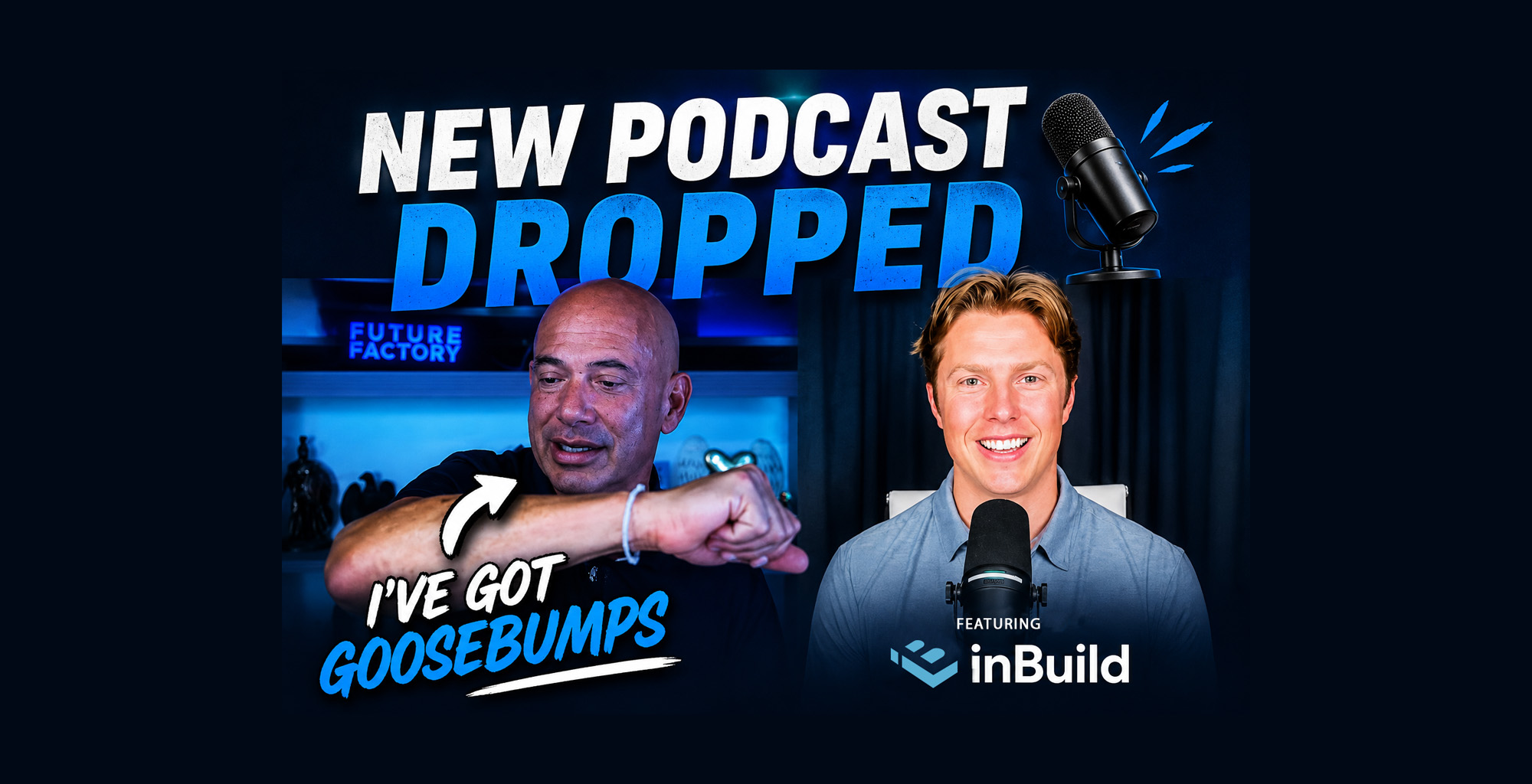
Ty, co-founder of inBuild, joined Anthony on his podcast for a wide ranging conversation about AI, legacy software, the death of paper based workflows, and the unconventional path that took him from S&P 500 data analytics, to a builder's basement in Colorado, to Y Combinator, to building the platform now used by contractors across the country.
You can watch the full episode here:
It's worth the 49 minutes. But if you want the highlights, here's what stood out.
The talent migration is reversing, and it's happening fast
For twenty years, the smartest kids in every graduating class were told to ship code, not pour concrete. Construction was for old timers. Software was for winners.
That equation just broke.
AI is eating the kind of entry level programming work that used to absorb every ambitious engineering grad in the country. And those young people, sharp, technical, hungry, are looking around for the next thing. As Anthony puts it on the show:
"As those jobs go away by the thousands every day, they're all looking at construction."
Ty's framing of this is what makes the episode click. He calls construction the largest green space left in technology. When he was sitting in Y Combinator next to MIT trained AI researchers all chasing the same dev tools customers, he was building for an industry where the share of the pie is enormous and most of the field is still working off paper.
"Just learn the process," he says. "Understand it. There's so much opportunity."
Why the old playbook for adopting software is dead
Anthony and Ty spend a good chunk of the episode on a problem every contractor recognizes: software rollouts that take months, require teams of trainers, and somehow still don't get adopted by half the company.
Ty's first real job in construction was implementing Procore for a Colorado builder. It took two months just to get the basic setup integrated with QuickBooks. The bookkeeper quit in the middle of it. He ended up doing the bookkeeping himself.
Compare that to today:
"Within inBuild, we're able to get a company set up in 15 minutes."
That's not just a feature improvement. It's a categorical shift in what's possible. And it matters because the speed of construction itself is accelerating. Anthony made the point that in 1990, his father, an architect acting as his own GC, could build a house in six months. The same type of house, twenty years later, was taking two years. The industry didn't just stop getting faster. It went backwards.
That window is closing. Companies that can't move from paper to digital, and from manually entered digital to AI automated digital, are going to get passed.
"Estimating is the bread and butter. You can't mess it up."
One of the strongest stretches of the conversation is Anthony explaining how his own team at CDO Group ended up building internal AI tools for estimating.
A typical ground up $3M project was taking his team two days just to scope. To hit their volume targets, they needed to knock out millions in new construction every week. The math didn't work. So they sat down with a team of prompt engineers and unwound the problem from scratch, every architect, every drawing convention, every line item.
It took two years.
This is the lesson Ty keeps returning to throughout the episode: the people who actually know the work are the ones who can build the tools. A construction veteran who understands where the bottlenecks really are, that's the person with the unfair advantage right now. Not a Stanford CS grad who's never set foot on a jobsite.
"If you understand the process, which I'm so grateful to have had the opportunity to work at a construction company to learn, that's the competitive edge. If you're just throwing stuff out, there's so much AI slop. If you don't know it deep down, you're not going to go anywhere."
The supply chain is about to get a wake up call
Anthony makes a prediction in the middle of the show that's worth pulling out separately:
"A company's days are limited today if they can't get from where they are today to a digital design and digital component. In a world where we're going to go much faster, AI won't be able to trust your supply chain if it doesn't understand all the way back to source material."
In other words: when AI is sourcing every screw, valve, and component at the design stage directly from Revit, your inventory living on triplicate paper forms is not going to cut it. The plumbing supply house Anthony walked through recently, hundreds of thousands of parts, still managed by hand, is the canary, not the exception.
There are thousands of those companies. Each one is a young person's opportunity.
The advice Ty would give a 22 year old right now
Toward the end of the conversation, Ty and Anthony talk about something most people in our industry don't say out loud: how many smart, capable young people are stuck.
Anthony describes spending a weekend with his buddy's sons, all college grads, all working low impact jobs, all paralyzed by trying to make the perfect choice. Ty's response is the closest thing to a thesis statement the whole episode has:
"Just pick a direction. The willingness to dive into the unknown, that's really what it is. If you just keep going, eventually you'll start to see the breadcrumbs that lead you to the light."
Anthony's blunter version, a few minutes later: "Everything amazing is on the other side of scaring the crap out of yourself."
The specific advice they keep circling: walk into the old school supply house, the small electrical contractor, the GC down the street that's still on filing cabinets. Offer to learn how their paper process works. Find the one thing they hate doing. Build a tool for it.
That's not theory. That's the exact path Ty took. He hated doing bookkeeping. He automated the part he hated. That automation became inBuild.
Why we wanted to share this conversation
Anthony's podcast was one of the more honest construction industry conversations we've been part of recently. Not a product demo, not a thought leadership performance, just two people who actually run companies talking about where this is all going.
If you're a contractor wondering whether AI is real or hype, a young person trying to figure out where to plant your career, or a tech worker who's been laid off and looking at construction for the first time, there's something in this for you.
▶️ Watch the full episode on YouTube
And if you want to see what Ty was talking about firsthand, what it actually looks like to get a construction company off paper and onto an automated finance stack in 15 minutes instead of two months, book a demo or get started with inBuild. If you already have a Procore account, you can connect it and start processing invoices today.
The robots can do the manual entry. Get back to building.