I was talking recently with the controller of a growing general contractor. He found us the way a lot of people do, by searching late one night for something that did what he needed. By then he'd already tried to build that tool himself.
"I got partway," he told me. "It just wasn't really working."
I like hearing that. People who have tried to build it themselves know exactly where the pain is.
"It works. I just can't trust it."
His setup was familiar: Procore for projects, QuickBooks Online for accounting, and an integration connecting the two. I asked how well the integration worked.
He paused. "It works. It doesn't work as well as I'd like. You can't trust it 100% that everything's synced up properly."
So his team double-checked, and sometimes entered things twice.
That may be the worst kind of broken. An integration you have to audit by hand gives you the cost of automation and still leaves the manual work. In financials, "mostly lines up" doesn't count as lining up.
The folder system
Then I asked how an invoice gets approved. His answer made me smile, because I had lived it myself.
"It comes into our payables email and gets sorted into a folder for the project. The PM reviews it right there in the inbox. If it's good, they drag it into an 'Approved' folder. Then someone enters it into the system."
"So your approval workflow is Gmail," I said.
He laughed. "Pretty much, yeah."
"That's a lot to keep track of and make sure nothing slips."
"It is."
About ten years ago I was hired to roll out Procore at a large general contractor. A few months in, the accountant retired. Soon after, the bookkeeper left. The hope that Procore would fix all our financial headaches landed on my desk. I spent ten hours a day in my inbox trying to keep up, and PMs would pull up in their trucks and dump piles of receipts on me. I know the folder system well, and I know how quietly it breaks down as a company grows.
He didn't want anything complicated. When I asked whether approvals needed multiple tiers, he said no. The PM approves it, and it should move on.
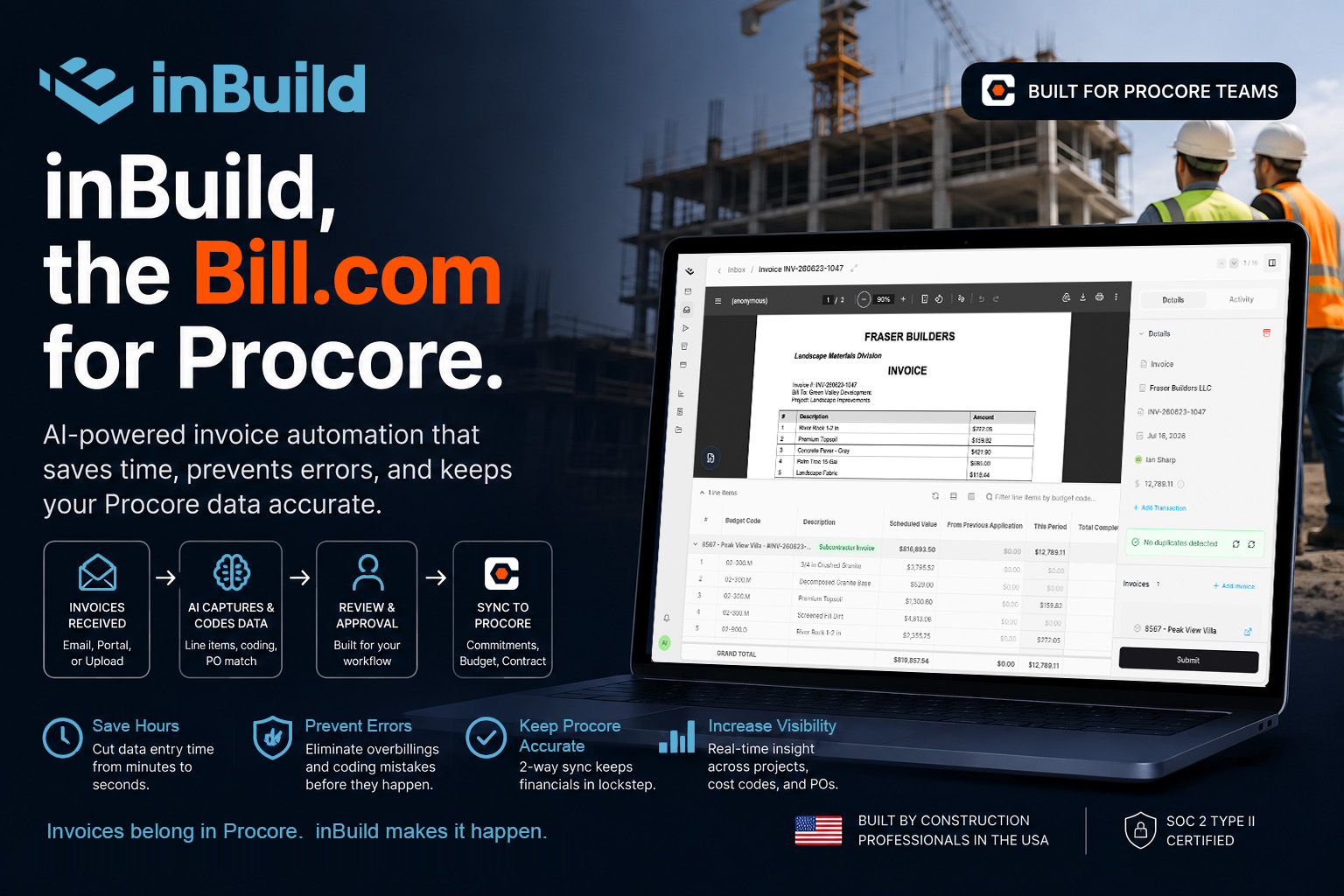
The nice part is that the information needed for this already exists. Procore knows who the project manager is on every job. When an invoice is coded to a project, it can route to that PM automatically. Nobody sorts it or drags it anywhere. Once the PM approves it, it goes to Procore and then to accounting on its own.
"That's what I was hoping it would be," he said.
Receipts on a separate track
Next we got to receipts. His field crew used a separate app to photograph receipts and send them in. He liked the app. The trouble was that it ran on its own track, apart from everything else.
"We can't run invoices through it," he explained, "because commitment claims have to go into Procore first and then over to accounting. It just doesn't work that way."
So invoices went one way and receipts went another, and his team pulled the two back together by hand.
What he really wanted was one place for everything. Company cards would connect directly. A cardholder would get a notification on their phone when a charge posted, snap the receipt right then, and be done. That receipt would land in the same inbox as the invoices and go through the same approval. Project costs would go to Procore. Overhead would go straight to accounting.
"I'd like the holistic approach," he said. "Unify it all in one."
Invoices come with paperwork
Partway through, he brought up something I think gets underestimated.
"When a sub sends in their invoice, it usually comes with other documents. A statutory declaration, which is kind of like a lien waiver, and their workers' comp clearance. That's part of our workflow, making sure those are there."
Subcontractor invoices rarely show up alone. They arrive as packages, and the supporting documents matter as much as the invoice itself. If an AP tool treats every PDF as a standalone invoice, somebody ends up back in Adobe splitting and merging files by hand. You need to be able to split a combined PDF, attach supporting documents to the invoice they belong to, and get back to the original email in one click.
Leverage before headcount
Near the end of our conversation, he said something that I think sums up where many contractors are right now:
"We're growing, and we want to make sure our people have as much leverage as they can with technology before we need to hire more."
That's the right way to look at it. The question isn't whether AI can read an invoice. It can. The question is whether the whole path works without someone watching it. That path runs from the email arriving, to project and cost-code coding, to sales tax, to the right approver, to Procore, to accounting, with anything that goes wrong visible instead of buried.
He said something else I've kept thinking about: "It looks like it was built specifically for this workflow."
In a way it was. It was built by someone who spent years in that inbox and wanted out.
If your approval workflow lives in an email folder today, you're in good company. You also don't have to keep it there.